How We Select and Rank
The sites on this page are selected based on five criteria: historical significance, current physical condition and visitor accessibility, quality of interpretation available on-site, proximity to other sites that allow for efficient multi-site planning, and value relative to entry cost. We weight these criteria equally and update rankings whenever a site's physical condition, access policy or interpretation changes substantially.
The list is not exhaustive — Egypt has more than 1,500 officially designated heritage sites. These fifty represent those where independent visitor access is most straightforward, where the experience most reliably repays the effort of travel, and where our research team has the most current, verified data. Use the Archaeological Sites page for a broader inventory including off-the-beaten-track locations.
Cairo & the Memphis Necropolis
Giza Pyramid Complex
The last surviving wonder of the ancient world and the most visited heritage site in Egypt. The complex encompasses the three pyramids of Khufu (the Great Pyramid), Khafre and Menkaure, the Great Sphinx, three queens' pyramids, workers' villages and the Solar Boat Museum. Despite extensive visitor infrastructure, the scale of the monument continues to overwhelm first-time visitors — nothing in photographs prepares you for the physical mass of Khufu's pyramid at close range.
The Great Pyramid was completed around 2560 BCE for pharaoh Khufu of the Fourth Dynasty. It required an estimated 2.3 million stone blocks averaging 2.5 tonnes each, quarried locally and transported to a limestone plateau at the desert's edge. The King's Chamber at its heart, reached by the Grand Gallery — a corbelled ascending passage 47 metres long — remains one of the most extraordinary architectural spaces in the ancient world.
Entry to the plateau is EGP 660. King's Chamber interior ticket: EGP 700. Khafre pyramid interior: EGP 400. Solar Boat Museum: EGP 200. Open daily 08:00–17:00 (16:00 in Ramadan). Camel rides are negotiated privately and prices are highly variable; agree a price before mounting. The plateau is wheelchair-accessible from the main gate to the Sphinx but the pyramid interiors are not. Best visited at opening time to beat tour group arrivals.
Grand Egyptian Museum
Opened in stages from 2023, the Grand Egyptian Museum (GEM) on the Giza plateau is the largest archaeological museum in the world by floor area, with 100,000 square metres of exhibition space housing more than 100,000 artefacts. The permanent galleries include the complete Tutankhamun collection — over 5,000 objects displayed together for the first time, including the golden death mask, the golden throne, the alabaster canopic chest and the nine royal chariots. The central atrium's 12-metre-high statue of Ramesses II visible from the entrance ramp is one of the most impressive internal architectural moments in any museum worldwide.
The museum's organisation follows a chronological sequence from prehistoric Egypt through the Pharaonic period to the Greco-Roman era. The Tutankhamun galleries occupy an entire dedicated wing at the southern end of the building. Allow a minimum of four hours for the main galleries; the Tutankhamun wing alone warrants two hours for a thorough visit. Audio guides are available in 11 languages for EGP 150.
Entry: EGP 750 general admission. Tutankhamun galleries additional: EGP 600. Open daily 09:00–21:00. The museum is fully accessible for wheelchair users. Photography is permitted throughout. See also our Day Tours page for Cairo one-day itineraries combining the GEM with the Giza plateau.
Saqqara Necropolis
Saqqara is the oldest and largest of the Memphis necropolis sites, used as a royal and elite burial ground for over 3,000 years. The Step Pyramid of Djoser — designed by the architect Imhotep around 2650 BCE — was the first large-scale cut stone structure ever built and the prototype from which all later Egyptian pyramid forms evolved. The pyramid itself reopened to visitors in 2020 after an extensive restoration programme. The surrounding funerary complex, enclosed by a ceremonial wall with 14 false doors and one functional entrance, is the best-preserved Third Dynasty royal precinct in Egypt.
Beyond the Step Pyramid, Saqqara contains the Pyramid of Unas (Fifth Dynasty), whose interior walls bear the earliest known example of the Pyramid Texts — religious spells that would evolve into the Book of the Dead. The Serapeum, an underground catacomb containing the massive granite sarcophagi of the Apis bulls (the living incarnation of the god Ptah), is among the most atmospheric spaces in Egyptian archaeology. The Tomb of Ti (Fifth Dynasty) features exceptionally detailed relief carvings of agricultural and hunting scenes.
Entry: EGP 450. Step Pyramid interior (where open): additional EGP 200. Serapeum: EGP 100. Tomb of Ti: EGP 100. Open daily 08:00–17:00. The site is extensive — allow a minimum of four hours. A taxi or guide vehicle is useful to connect the widely spaced sites within the necropolis. Read our Archaeological Sites guide for coverage of adjacent sites at Dahshur and Abu Sir.
Luxor — Ancient Thebes
Karnak Temple Complex
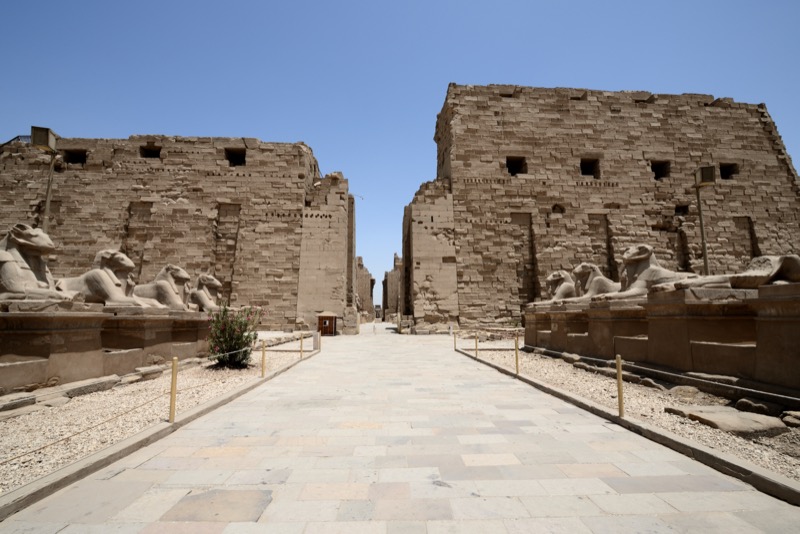
The largest religious building complex ever constructed, Karnak grew over a period of approximately 1,300 years as successive pharaohs added pylons, hypostyle halls, obelisks and subsidiary temples. At its peak, the estate of the god Amun at Karnak covered more than 2 km² and employed tens of thousands of priests. The site is divided into three main precincts: the Precinct of Amun-Ra (the largest and most visited), the Precinct of Mut, and the Precinct of Montu. A ceremonial avenue of ram-headed sphinxes, recently restored, connects Karnak to Luxor Temple 2.7 kilometres to the south.
The Great Hypostyle Hall is the centrepiece of the Amun precinct and the single most impressive internal architectural space in ancient Egypt. Covering 5,406 square metres and supported by 134 sandstone columns — the central aisle's 12 columns standing 21 metres high with capitals large enough to stand 100 people — the hall was begun by Seti I and completed by Ramesses II. Its walls retain traces of original polychrome paint in sheltered areas. The sacred lake, the obelisks of Hatshepsut and Thutmose I, and the Luxor Cachette Courtyard (where over 17,000 statues were found buried in 1903) are all essential points within the complex.
Entry: EGP 450. Open daily 06:00–17:30. Arrive at 06:00 for dramatically reduced crowds. The site covers several kilometres; comfortable walking shoes are essential. The sound and light show runs on most evenings (times vary seasonally; tickets EGP 250). See also our West Bank day tour itinerary for combining Karnak with the Valley of the Kings.
Luxor Temple
Constructed primarily under Amenhotep III (c. 1390–1352 BCE) and substantially expanded by Ramesses II, Luxor Temple served as the focal point of the Opet Festival, during which the statue of Amun was ceremonially transported from Karnak to be reunited with his consort Mut. Unlike Karnak, which sprawls across a vast estate, Luxor Temple is a coherent, compact monument that can be thoroughly explored in two hours. Its orientation and plan — the great pylon of Ramesses II, the open court, the colonnade of Amenhotep III, the inner sanctuary — remain largely intact and clearly legible.
The temple was buried under metres of Nile silt for centuries; the medieval mosque of Abu Haggag, built over one of the courts before the site was excavated, remains in active use inside the complex — an extraordinary palimpsest of religious history. The four seated colossi of Ramesses II at the pylon entrance are among the finest royal statues in Egypt. Best visited at dusk or immediately after, when the warm floodlighting transforms the pink sandstone. The recently restored avenue of sphinxes leading north toward Karnak is the most photogenic route between the two temples.
Entry: EGP 450. Open daily 06:00–22:00. The combination of evening light and reduced crowds after 19:00 makes this the ideal evening monument in Luxor. Located in the centre of Luxor town, walkable from most hotels on the Corniche. Also see our Seasonal Events guide for Opet Festival revival dates.
Valley of the Kings
The primary royal burial ground of the New Kingdom pharaohs, used from approximately 1539 to 1075 BCE, the Valley of the Kings contains 63 known tombs and pits cut deep into the limestone cliffs of the West Bank. The tombs vary enormously in scale, condition and accessibility. A standard entry ticket covers three tombs of the visitor's choosing from a rotating selection of open tombs (currently 20–24 open at any time). The tombs of Tutankhamun (KV62), Seti I (KV17) and Ramesses V–VI (KV9) require separate tickets but offer the finest decoration or best-preserved interiors.
The Tomb of Ramesses V–VI (KV9) is considered the single most impressive accessible tomb: its long descending corridors are covered floor-to-ceiling with scenes from the Books of the Dead, the Gates, the Caverns and the Earth, painted in vivid ochre, turquoise and white that has survived largely intact owing to the tomb being sealed under rubble shortly after completion. The Tomb of Tutankhamun (KV62) is small but uniquely resonant — the antechamber where Howard Carter broke through on 4 November 1922 remains visible in context.
Standard entry: EGP 600. Tutankhamun: additional EGP 500. Seti I: additional EGP 2,000. Open daily 06:00–17:00. A shuttle vehicle (taftaf) operates within the valley. Best visited immediately at opening or after 14:00 when morning coach tours have departed. Combine with Deir el-Bahari (Hatshepsut's temple) and the Colossi of Memnon for a full West Bank day — see our Day Tours for a planned route.
This page covers a selection of our full 50-site catalogue. Need a guide pack covering all sites relevant to your specific itinerary?
Request a Guide Pack See Archaeological Sites